
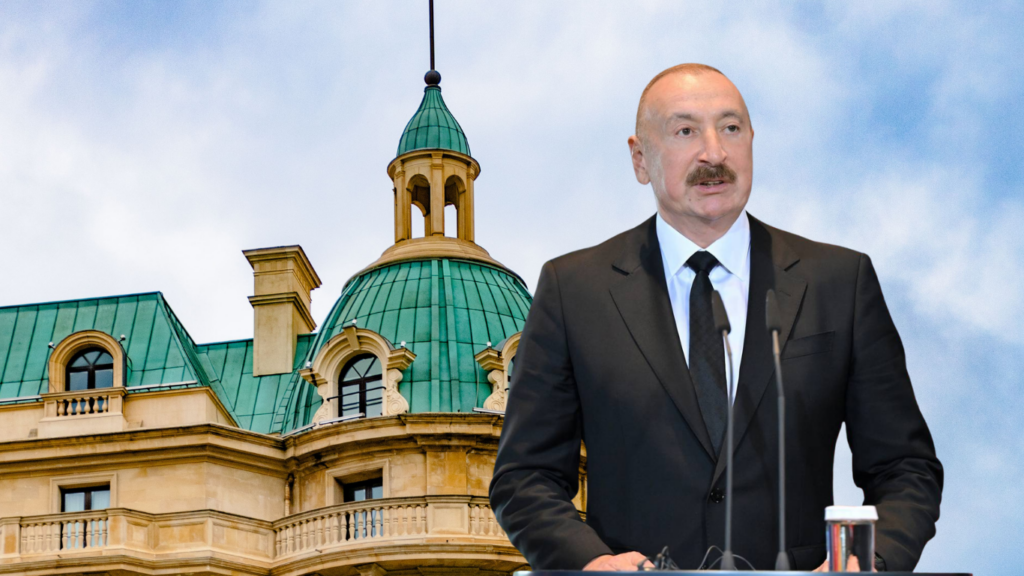
BAKU — A series of previously undisclosed meetings between German politicians and senior Russian officials at the five-star Four Seasons Hotel in Baku has drawn renewed attention following comments by German Chancellor Friedrich Merz and Azerbaijani President Ilham Aliyev.
Die Zeit recently reported that a confidential meeting concerning the Russia-Ukraine war took place in Baku between July 12 and 14. While the publication focused on the identities of the participants and the purpose of the talks, it did not address the ownership of the hotel where the meeting was reportedly held.
According to the report, the German delegation included Ronald Pofalla, former chief of staff to former Chancellor Angela Merkel, and German politician Matthias Platzeck. Former Prime Minister Viktor Zubkov and Valery Fadeyev, an adviser to Russian President Vladimir Putin, represented the Russian side.
The reported meeting became a topic of public discussion after Chancellor Friedrich Merz stated during a joint press conference with President Ilham Aliyev in Berlin on July 21 that he had not been informed about the gathering.
Responding to the remarks, Aliyev said Azerbaijani authorities had confirmed through State Border Service flight records that Pofalla, Platzeck, Zubkov, and Fadeyev had entered Azerbaijan. However, he neither confirmed nor denied that a meeting had taken place.
“Our territory was used without our knowledge,” Aliyev said, adding that flight records suggested such a meeting had occurred in Baku.
It was precisely this statement that cast an even darker shadow over the information published by the German newspaper. Although the venue where the meeting took place might not have made much of an impression on German readers, it is very familiar to Azerbaijanis.
The Four Seasons Hotel Baku is managed by Absheron Hotel Group LLC, a company operating under PASHA Holding, which has been widely reported to be owned by members of President Aliyev’s family.
The July meeting was reportedly not the first contact between German political figures and Russian officials in Baku. Similar meetings are said to have begun in 2024.
According to previous reporting, representatives from both countries met at the Four Seasons Hotel on April 21–22, 2024. Mikhail Shvydkoy, Russian President Vladimir Putin’s special representative for international cultural cooperation, confirmed the meeting in response to inquiries from German public broadcaster ARD and Die Zeit. Shvydkoy, who attended the talks, said participants discussed Russia’s current and future relations with Germany.
Investigative journalists reported that the April 2024 meeting was organized within the framework of the “Petersburg Dialogue,” a forum established in 2001 by Russian President Vladimir Putin and former German Chancellor Gerhard Schröder to promote dialogue between Russian and German civil societies. Although the initiative was officially suspended after Russia’s full-scale invasion of Ukraine in 2022, the reported contacts appear to have continued.
On October 16, 2024, journalists published an agenda for another planned meeting scheduled for October 20. According to the leaked program, prominent German and Russian participants were expected to meet for a dinner at the Four Seasons Hotel before holding discussions on German-Russian cooperation the following day. ARD’s political magazine Kontraste and Die Zeit reported that the program carried the official logo of the Petersburg Dialogue.
Another reported meeting took place in Baku on April 13–14, 2025, again at the Four Seasons Hotel. According to Kontraste, the German delegation included Social Democratic Party lawmaker and foreign policy expert Ralf Stegner, Ronald Pofalla, former North Rhine-Westphalia minister for federal and European affairs Stefan Holthoff-Pförtner, and former Petersburg Dialogue executive director Martin Hoffmann.
The Russian delegation reportedly included former Prime Minister Viktor Zubkov, who also chairs Gazprom’s supervisory board, and Valery Fadeyev, head of the Russian Presidential Council for Human Rights.
Arif Yunus, deputy director of the Institute for Peace and Democracy, told Azerbaijani outlet Qazetci that it was difficult to believe President Aliyev had been unaware of the meetings in a country with extensive state oversight.
“The participation of individuals close to both Merkel and Putin indicates that Ilham Aliyev was aware of the process. Most likely, holding the meetings in Baku was carried out at Putin’s recommendation,” Yunus said.
Former diplomat and political analyst Nihad Jafarov expressed a similar view, telling Qazetci that it would be impossible to organize such meetings in Baku without the knowledge of the country’s centralized leadership.
The reported meetings have generated criticism in both Azerbaijan and Germany. While Aliyev has faced questions over Azerbaijan’s role in hosting the talks, Chancellor Merz has also come under scrutiny domestically.
German parliamentarian Roderich Kiesewetter told Radio Free Europe/Radio Liberty’s Azerbaijani Service that the German government was aware of the meeting but did not prevent it from taking place.
Kiesewetter argued that Russia is attempting to influence Germany’s policy on supporting Ukraine. According to him, Moscow is seeking to weaken European backing for Kyiv after failing to achieve its objectives militarily.
“The aim is to weaken Europe’s support for Ukraine, and Germany is one of the key countries in this regard. The objective is to ease sanctions against Russia while increasing pressure on Ukraine to enter what would be sham negotiations,” he said.
During the Berlin press conference, President Aliyev stated that Azerbaijan would welcome any initiative capable of ending the Russia-Ukraine war.
“If this meeting will help end the Ukraine-Russia war, then of course we welcome it,” Aliyev said.
However, Ukrainian Foreign Ministry spokesperson Heorhii Tykhyi said the informal meeting between German politicians and Russian officials in Baku would not influence efforts to end the war.
The European Union considers Russian President Vladimir Putin responsible for the war against Ukraine and has sought to pressure Moscow into meaningful negotiations.
Critics argue that informal or undisclosed meetings between German and Russian representatives risk undermining that strategy, describing them as a sign of weakness and a potential backchannel for negotiations outside official diplomatic frameworks.
Afgan Mukhtarli