
On June 18, a family visiting the beach in Dubandi, a village at the shore of the Caspian Sea, witnessed a shocking scene. Water snakes that had emerged from the sea and curled up on the coastal rocks—normally bright green in color—were instead coated in thick black oil.
The sight offered a stark illustration of the environmental damage caused by an oil spill that leaked into the Caspian Sea from the Dubundi oil terminal in mid-June.
“They are completely black,” a woman says in a video as she and her child carefully clean the snakes with wipes before releasing them back into the sea.
“We managed to clean two of the little ones. There’s another one that’s completely covered in oil. The main thing is to clean its head so it can breathe. Poor thing can’t even see where it’s swimming.”
By June 20, residents reported that the oil slick had spread as far as the coast of Shuvalan. A young man who went swimming emerged from the water with his body stained by oil, as heavily as the snakes.
After videos of the contamination circulated widely on social media, Azerbaijan’s Ministry of Emergency Situations and the State Oil Company of the Azerbaijan Republic (SOCAR) were compelled to issue a joint statement.
According to the statement, the pollution in the waters between Pirallahi island and Dubandi was caused by a leak from one of the underwater oil pipelines operated by SOCAR’s Azneft Production Union.
“As soon as the source of the leak was identified, oil transportation through the affected underwater pipeline was suspended. Azneft Production Union immediately established an operational headquarters to manage the incident, and the situation has been brought under control,” the statement said.
Azneft said the damage to the underwater pipeline was “mechanical in nature.”Preliminary assessments indicate that the damage was caused by contact with an external object, most likely an anchor,” the statement added.
Following the discovery of the leak, personnel from the Ministry of Emergency Situations, together with soldiers, attempted to clean up the oil along the coastline using shovels and plastic bags, handling the oil with their bare hands and without any protective equipment.
SOCAR has not disclosed the volume of oil that leaked into the sea. Nor have any government agencies commented on the environmental damage caused by the contamination or its impact on marine life in the Caspian Sea.
The environmental activist group Ecofront said in a social media statement that leaks from underwater oil pipelines can have serious consequences for a fragile ecosystem such as the Caspian Sea.
“Under international standards, the primary requirement during oil production and transportation is to minimize the risk of spills. This requires regular technical inspections of pipelines, corrosion protection, real-time monitoring systems, and automatic shut-off mechanisms,” the group said.
Oil forms a thick layer on the surface of the water, reducing the exchange of oxygen between the atmosphere and the sea.
“This makes it difficult for fish, plankton, and other aquatic organisms to breathe, causing widespread stress. Toxic substances contained in oil enter the food chain, triggering a process of bioaccumulation that affects everything from small organisms to larger fish and, ultimately, humans,” Ecofront mentioned.
The group added that the spill also threatens rare species such as the Caspian seal. In addition to marine life, seabirds are also affected by oil contamination.
“Oil coating their feathers prevents seabirds from flying, disrupts their ability to regulate body temperature, and often poisons them as they attempt to clean themselves. Coastal ecosystems also suffer severe damage: soil, vegetation, and breeding grounds become contaminated, and recovery can take years”.
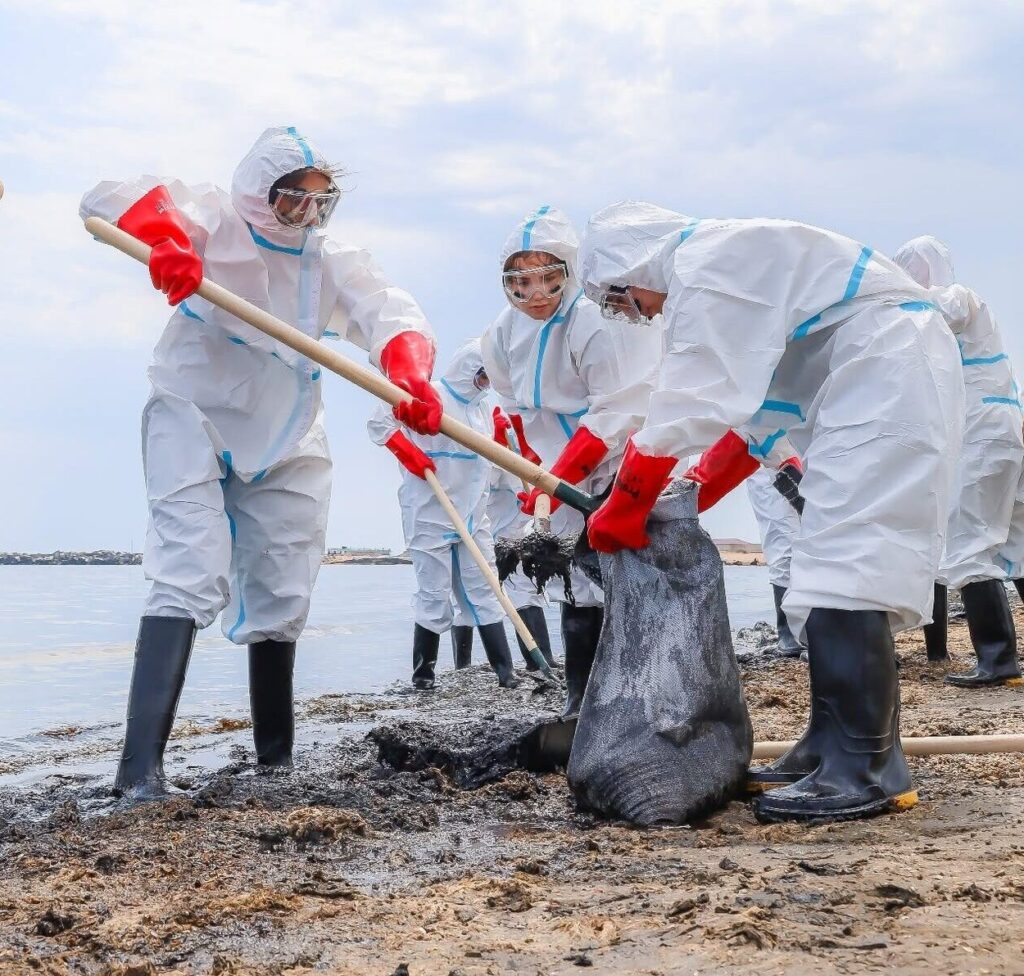
On June 23, IDEA Public Union, an environmental organization founded by Leyla Aliyeva, daughter of President Ilham Aliyev, shared photographs on social media showing volunteers cleaning the contaminated shoreline at Dubandi beach.
The images show volunteers wearing protective clothing collecting oil-contaminated sand and soil into bags. However, no information was provided about how the collected waste would be disposed of.
A spokesperson for the Ministry of Ecology and Natural Resources told Qazetci that responsibility for the country’s water bodies was transferred about a year ago from the ministry to the Azerbaijan State Water Resources Agency (ADSEA).
The State Service for Water Use and Protection, which operates under ADSEA, told Qazetci that the accident occurred on a steel pipeline transporting crude oil from the Absheronneft Oil and Gas Production Department’s Oil Processing and Transportation Facility to the crude oil storage tank farm at the Dubandi oil terminal.
The Absheronneft Oil and Gas Production Department operates under SOCAR’s Azneft Production Union.
The agency said that floating containment booms were deployed immediately to prevent the oil slick observed in the Caspian Sea from spreading further, limiting “the spread of the oil over a wider area under the influence of wind and sea currents.”
Despite these measures, videos shared on social media showed the oil pollution spreading to the shores of Shuvalan and other nearby coastal areas.
“The volume of petroleum products discharged into the Caspian Sea as a result of the incident is currently being determined. In addition, the environmental damage caused to the water body is being assessed in accordance with the standards approved by Cabinet of Ministers Resolution No. 308 of August 17, 2022,” the agency said.
This is not the first incident in the area. A similar one occurred in February last year. The news outlet Qafqazinfo.az reported that a leak had been detected on the Neft Daşları–Çilov–Shah Saçı–Dübəndi oil pipeline operated by Azneft Production Union. The pipeline transports oil and condensate from the Neft Daşları offshore field to the Dubandi terminal.
Because the spill occurred during the winter, adverse weather conditions delayed repair work, with maintenance crews waiting for conditions at sea to improve before carrying out restoration operations.
Mirvari Gahramanli, head of the Oil Workers’ Rights Protection Organization, told Qazetci that another oil pipeline leak had also been recorded in 2024.
“SOCAR suspended operations on the pipeline after an accident in February 2024 involving the line transporting oil from the Neft Daşları, Gunashli, and Garabagh fields,” the labor rights advocate said.
She mentioned that despite the pipeline accident remaining unresolved for more than a year, SOCAR’s management failed to take adequate action.
“Because it was the end of the month and there was pressure to minimize the shortfall in oil production targets, pressure in the 20-inch and 14-inch pipelines was increased. This placed additional strain on the lines. Since these pipelines had been in operation for many years and already had damaged sections, they required major repairs. However, no underwater maintenance work was carried out during the summer season,” she added.
As a result, Gahramanli said that on January 31 last year, the 20-inch pipeline leading to the Dubandi terminal was found to have ruptured in two places. Although the leak was eventually contained, she estimated that nearly 1,000 cubic meters of oil had spilled into the surrounding area.
According to Gahramanli, recurring leaks from oil pipelines are the result of inadequate maintenance, the dismissal of experienced and qualified personnel, and corruption within the sector.
Neither SOCAR nor Azneft Production Union has published any information about the oil spill on their official social media accounts.